Gearbox vs Direct Drive: Choosing the Right Power Transmission for Your Application
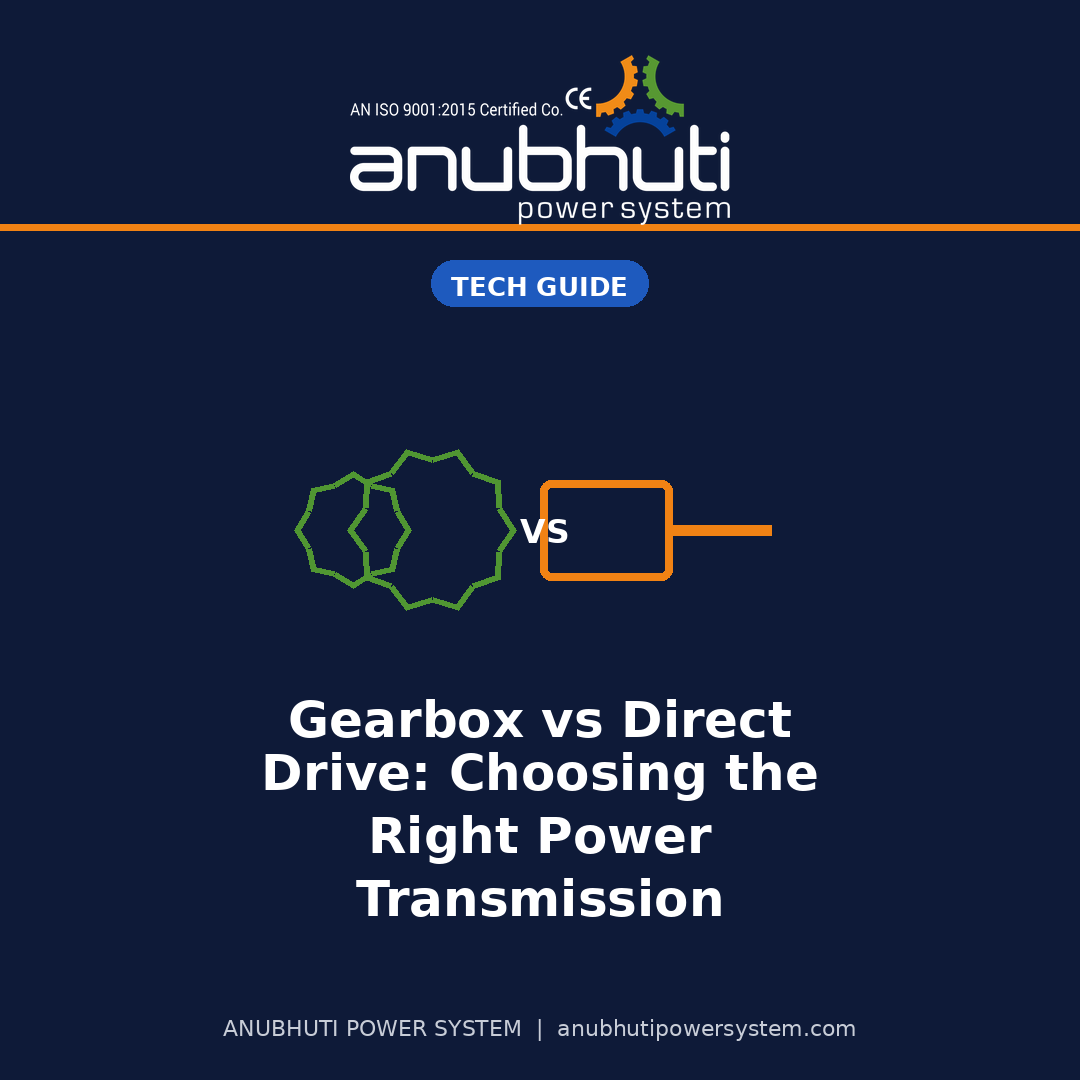
Every piece of industrial machinery that converts motor rotation into useful mechanical work faces a fundamental design decision: use a gearbox to adjust speed and torque, or connect the load directly to the motor shaft. Both approaches have a long track record across Indian industry, and the right choice depends heavily on your specific torque, speed, and space requirements. This guide compares gearbox-driven and direct-drive systems to help you make the right call for your application.
 What Is a Geared Drive System?
A geared drive system uses a gearbox between the motor and the driven load to adjust rotational speed and multiply torque, allowing a relatively compact, high-speed motor to drive a slower, higher-torque application. Helical, worm, and planetary gearboxes are common choices depending on the ratio and torque requirements involved.
What Is a Direct Drive System?
A direct drive system connects the motor shaft directly to the load, with no gearbox in between, meaning the motor’s native speed and torque characteristics are applied directly to the application. This requires the motor itself to be designed or selected to match the load’s speed and torque needs without mechanical amplification.
Comparing Torque and Speed Flexibility
Gearboxes offer significant flexibility, allowing a single standard motor to be paired with different gear ratios to achieve a wide range of output speeds and torque levels. Direct drive systems, by contrast, require selecting or designing a motor whose native characteristics already match the application, which can limit flexibility but simplifies the overall system.
Comparing Mechanical Efficiency
Every additional mechanical stage introduces some energy loss, meaning a gearbox — even a well-designed one — typically introduces more transmission loss than a direct drive system, where power flows straight from motor to load with no intermediate gearing. For high-precision or high-efficiency applications, this makes direct drive an attractive option where it’s practically achievable.
Comparing Maintenance Requirements
- Gearbox systems require periodic lubrication, gear wear inspection, and eventual gearbox rebuilds or replacement
- Direct drive systems eliminate gearbox-related maintenance entirely, though motor maintenance still applies
- Gearboxes add a component that can fail independently of the motor, increasing the number of possible failure points
- Direct drive simplifies the maintenance picture by reducing the drivetrain to a single component
Comparing Cost Considerations
Gearbox systems often use a smaller, less expensive standard motor paired with a gearbox to achieve the needed output characteristics, which can be more cost-effective upfront than sourcing a specialized direct-drive motor engineered for the exact torque and speed required. However, gearbox systems carry ongoing maintenance costs that direct drive avoids over the long run.
Comparing Space and Footprint
Direct drive systems typically have a more compact overall footprint since there’s no gearbox housing to accommodate, which can be a meaningful advantage in space-constrained installations. Gearbox systems require additional space for the gearbox unit and its mounting, coupling, and access for maintenance.
When a Gearbox System Makes Sense
- Applications requiring high torque at low speed, where gear reduction is the practical way to achieve this from a standard motor
- Facilities wanting flexibility to adjust output characteristics by swapping gear ratios rather than motors
- Applications where a lower upfront motor cost is prioritized over long-term maintenance simplicity
When Direct Drive Makes Sense
- Applications where mechanical efficiency and reduced maintenance are top priorities
- Space-constrained installations where gearbox footprint is a genuine constraint
- High-precision applications where eliminating gearbox backlash and wear improves control accuracy
- Facilities looking to minimize long-term maintenance points in the drivetrain
Making the Right Choice for Your Application
The decision ultimately comes down to your specific torque, speed, space, and maintenance priorities. Many facilities actually run both approaches side by side, using gearboxes where flexibility and lower upfront cost matter most, and direct drive where efficiency, precision, or reduced maintenance are the priority.
How Anubhuti Supports Both Approaches
Anubhuti Power System manufactures a full range of gearboxes — helical, worm, NMRV, planetary, and extruder types — alongside our motor range, and our team can help you evaluate whether a geared or direct-drive approach better fits your specific torque, speed, and maintenance requirements.