⚙️ How a Planetary Gear System Works – Explained with Diagram
Planetary gear systems are widely used in industrial machinery, robotics, automotive transmissions, and heavy equipment because of their high torque capacity, compact design, and efficiency.
In this blog, we will explain how a planetary gear system works, its components, motion mechanism, and why it is preferred in modern engineering.
🔹 What Is a Planetary Gear System?
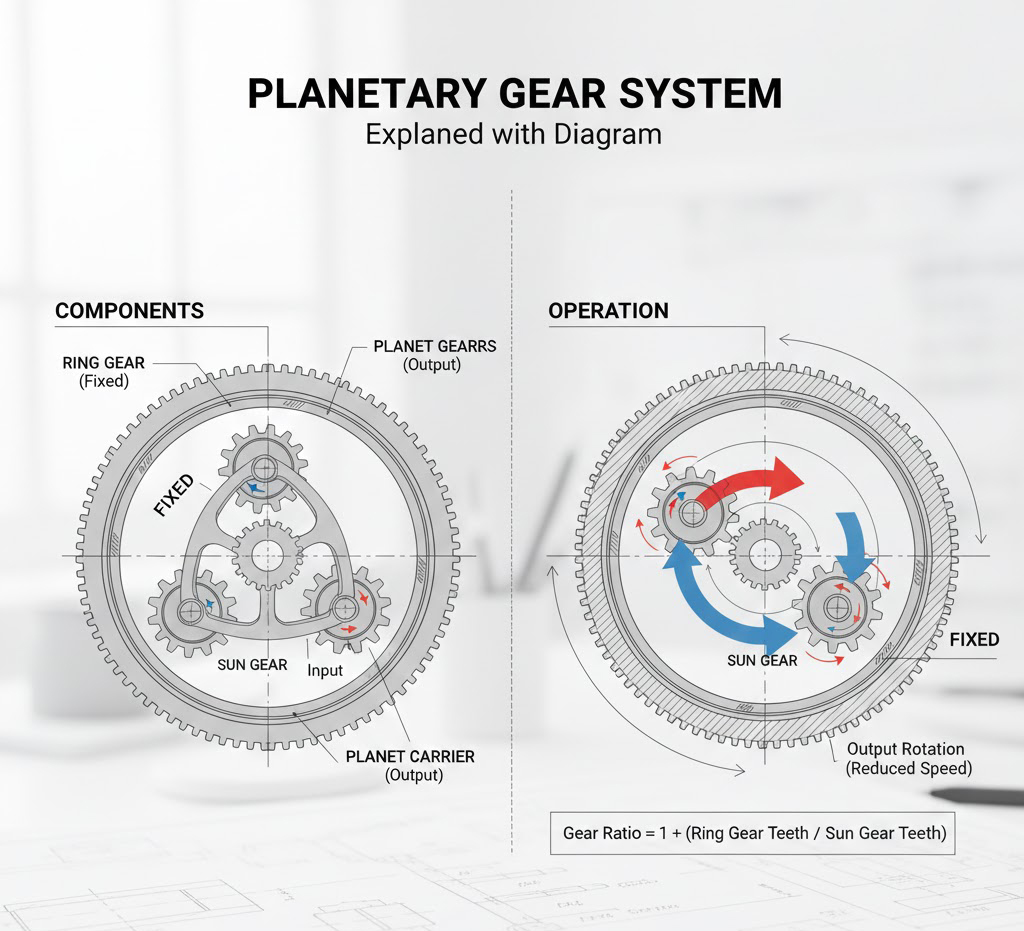
A planetary gear system (also called an epicyclic gear system) is a gear arrangement consisting of:
- A Sun Gear (center gear)
- Multiple Planet Gears
- A Planet Carrier
- An outer Ring Gear (Annulus)
Unlike traditional gear systems, planetary gears rotate around a central gear — similar to how planets revolve around the sun. That’s how it gets its name.
🧩 Main Components of a Planetary Gear System
1️⃣ Sun Gear
The central gear in the system. It is usually the input gear that receives power from the motor.
2️⃣ Planet Gears
Small gears that revolve around the sun gear. They mesh with both the sun gear and the ring gear.
3️⃣ Planet Carrier
A structure that holds the planet gears and rotates with them.
4️⃣ Ring Gear (Annulus)
The outer gear with internal teeth. It surrounds the planet gears.
📊 Simple Diagram of a Planetary Gear System
Below is a simplified representation:
————————-
| Ring Gear |
| (Internal Teeth) |
| |
| o o o |
| \ | / |
| (Sun) |
| Planet Gears |
————————-
Planet Carrier
How It Is Arranged:
- The sun gear sits at the center.
- The planet gears rotate around it.
- The ring gear surrounds the system.
- The carrier holds and supports the planets.
🔄 How a Planetary Gear System Works
The working depends on which component is fixed and which is driven. This flexibility allows multiple speed and torque combinations.
🔹 Case 1: Sun Gear as Input, Ring Gear Fixed
- The motor drives the sun gear.
- The ring gear remains stationary.
- The planet gears rotate around the sun.
- The carrier becomes the output.
Result:
✔ Speed reduction
✔ High torque output
This is the most common industrial setup.
🔹 Case 2: Ring Gear as Input, Sun Gear Fixed
- Power is applied to the ring gear.
- The sun gear remains fixed.
- The carrier rotates.
Result:
✔ Different speed ratio
✔ Smooth torque transmission
🔹 Case 3: Carrier as Input
In some systems:
- The carrier acts as input.
- The sun or ring may be fixed.
- Produces different rotational outputs.
This configuration is often used in automatic transmissions.
⚡ Why Planetary Gear Systems Are So Efficient
Planetary gearboxes are highly efficient because:
✔ Load is shared among multiple planet gears
✔ Compact and space-saving design
✔ High torque in small size
✔ Smooth and balanced operation
✔ Less vibration
Load distribution is a major advantage — instead of one gear handling all force, multiple planet gears share the load.
📐 Gear Ratio in Planetary System
The gear ratio depends on:
- Number of teeth on sun gear
- Number of teeth on ring gear
- Number of planet gears
Example:
If the ring gear is fixed and the sun gear drives the system, the gear ratio formula is:
GearRatio=1+RingGearTeethSunGearTeethGear Ratio = 1 + \frac{Ring Gear Teeth}{Sun Gear Teeth}GearRatio=1+SunGearTeethRingGearTeeth
This allows high reduction ratios in compact space.
🏭 Where Planetary Gear Systems Are Used
Planetary gear systems are commonly used in:
- Robotics
- CNC machines
- Conveyor systems
- Wind turbines
- Automotive automatic transmissions
- Construction machinery
- Industrial automation
Their compact size and high torque make them ideal for modern machinery.
🔍 Advantages of Planetary Gear Systems
✔ High torque density
✔ Compact structure
✔ Multiple gear ratios possible
✔ Smooth power transmission
✔ High efficiency (95–98%)
✔ Better load distribution