Planetary Gearbox vs Helical Gearbox: Which Is Better for Heavy Loads?
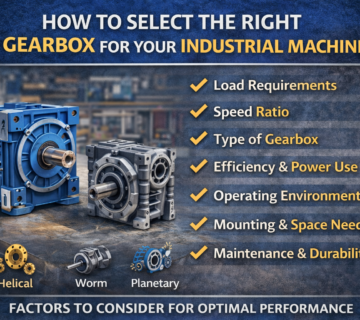
Choosing the right gearbox is critical for industries that handle heavy loads, high torque, and continuous operations. Two of the most commonly used gearboxes for such applications are Planetary Gearboxes and Helical Gearboxes. While both are reliable and efficient, their design, performance, and load-handling capabilities differ significantly.
At Anubhuti Power System, we help industries select the most suitable gearbox based on load requirements, operating conditions, and long-term performance. In this blog, we compare planetary and helical gearboxes to determine which is better for heavy-load applications.
Understanding Planetary Gearboxes
A planetary gearbox consists of three main components:
-
Sun gear (central gear)
-
Planet gears (multiple gears rotating around the sun gear)
-
Ring gear (outer gear with internal teeth)
This unique design allows the load to be distributed across multiple planet gears, resulting in high torque transmission in a compact size.
Key Characteristics of Planetary Gearboxes
-
Extremely high torque density
-
Compact and lightweight design
-
Excellent load sharing
-
High efficiency (up to 97%)
-
Low backlash and high precision
Understanding Helical Gearboxes
A helical gearbox uses helical-cut gears where the teeth are angled to the gear axis. This design provides smooth and quiet power transmission and is commonly used in industrial machinery.
Key Characteristics of Helical Gearboxes
-
Smooth and low-noise operation
-
High mechanical efficiency
-
Strong and durable construction
-
Suitable for continuous duty
-
Cost-effective for medium to heavy loads
Load-Handling Capability Comparison
Planetary Gearbox for Heavy Loads
Planetary gearboxes excel in heavy-load applications because:
-
Load is evenly distributed among multiple planet gears
-
Higher torque can be transmitted without increasing gearbox size
-
Reduced stress on individual gears
This makes planetary gearboxes ideal for very high torque and shock-load conditions.
Helical Gearbox for Heavy Loads
Helical gearboxes can handle heavy loads, but:
-
Load is transmitted through fewer gear teeth
-
Gear size must increase to handle higher torque
-
Less compact compared to planetary gearboxes
They are best suited for moderate to heavy loads rather than extremely high torque in limited space.
Size and Space Efficiency
-
Planetary Gearbox: Highly compact with high power-to-weight ratio, perfect where space is limited.
-
Helical Gearbox: Larger and heavier for the same torque capacity.
For heavy loads in compact machinery, planetary gearboxes clearly have the advantage.
Torque Density and Power Transmission
Torque density refers to how much torque a gearbox can handle relative to its size.
-
Planetary Gearbox: Very high torque density due to multiple gear contact points.
-
Helical Gearbox: Lower torque density; requires larger gears to handle similar loads.
For high-torque applications such as crushers, mixers, and construction machinery, planetary gearboxes perform better.
Efficiency and Performance Under Load
Both gearboxes are efficient, but:
-
Planetary Gearboxes maintain high efficiency even under heavy loads due to balanced load distribution.
-
Helical Gearboxes are efficient but may experience higher losses at extreme torque levels.
For continuous heavy-load operations, planetary gearboxes provide more consistent performance.
Durability and Service Life
-
Planetary Gearbox: Longer service life due to reduced wear on individual gears.
-
Helical Gearbox: Durable, but gear wear increases with higher loads.
In demanding environments with high shock loads, planetary gearboxes offer superior durability.
Noise and Vibration
-
Helical Gearboxes: Quieter operation due to gradual tooth engagement.
-
Planetary Gearboxes: Slightly higher noise, but modern designs minimize vibration.
For noise-sensitive environments, helical gearboxes may be preferred.
Cost Consideration
-
Planetary Gearbox: Higher initial cost but better long-term value for heavy loads.
-
Helical Gearbox: Lower upfront cost, economical for moderate heavy-load applications.
When long-term reliability and compactness are priorities, planetary gearboxes justify the investment.
Heavy-Load Industrial Applications
Planetary Gearboxes Are Best For:
-
Construction and mining machinery
-
Crushers and mixers
-
Wind turbines
-
Heavy conveyors
-
Robotics and automation
Helical Gearboxes Are Best For:
-
Cement and steel plants
-
Material handling systems
-
Packaging machinery
-
Textile and printing equipment
Final Verdict: Which Is Better for Heavy Loads?
For extreme heavy loads, high torque, and compact design requirements, planetary gearboxes are the superior choice. Their ability to distribute load across multiple gears ensures better performance, durability, and efficiency.
For moderate heavy loads with continuous operation and cost sensitivity, helical gearboxes remain a reliable and economical solution.
Why Choose Anubhuti Power System?
At Anubhuti Power System, we supply high-quality planetary and helical gearboxes engineered for industrial reliability and performance. Our expert team helps you select the right gearbox based on:
-
Load capacity
-
Operating conditions
-
Space constraints
-
Application requirements
Anubhuti Power System – Delivering Power, Precision & Performance for Heavy-Duty Industries.